
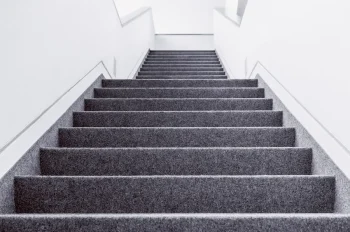
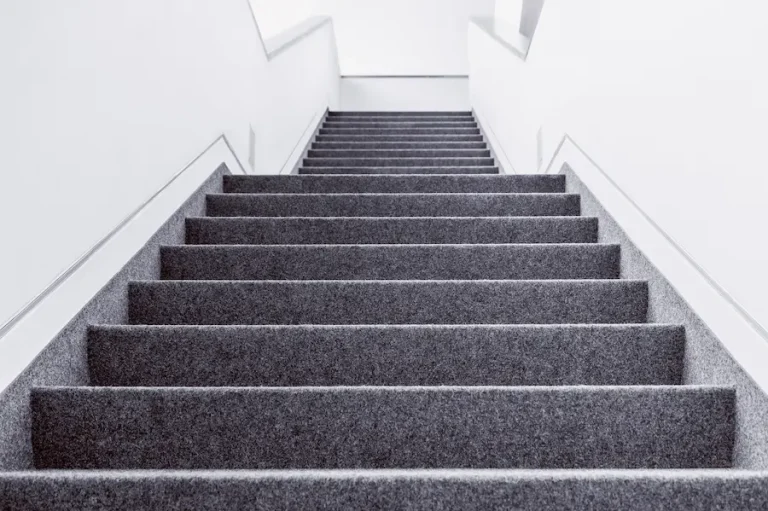
The best carpet for stairs is dense and low, with a tight twist, laid over a thin, firm pad no thicker than 7/16 inch. Nylon bounces back from foot traffic better than polyester, so it is the strongest pick for a busy staircase. A low pile wraps cleanly over the edge of each step and gives bare feet, socks and paws better grip than hardwood.
Quick Facts
- Stairs need a thinner, firmer pad than bedrooms. The Carpet and Rug Institute recommends cushion no thicker than 7/16 inch for residential carpet and names stairs among the areas that need firmer cushion.
- Nylon recovers from foot traffic better than polyester, and the difference shows most on stairs and in hallways. Our nylon vs. polyester comparison covers the trade-off.
- A low, dense pile bends over the nose of each step without the backing showing through, and it shows less wear where feet land.
- Loop pile, like Berber, wears well, but a dog’s or cat’s claws can catch a loop. In homes with pets, a dense cut pile is the safer choice.
- Stairs get their own line on a Carpet Now quote: the carpet at your grade’s price plus a $250 stair fee for a standard staircase.
Stair Carpet Styles at a Glance
- Frieze: tightly twisted cut pile that hides footprints and wear, and a strong choice for a busy family staircase.
- Textured cut pile: a soft, casual surface that hides footprints and suits most stairs.
- Level loop or Berber: low and very durable, and best on stairs in homes without pets.
- Plush or velvet: the softest look, but it shows footprints and wear on the edge of each step, so it belongs in bedrooms.
Schedule your free in-home estimate and see how each sample wraps the edge of your own stairs before you choose.
Stairs take more wear than any other carpeted spot in a home. Every trip up or down lands on the same few inches of each step, and the carpet has to bend over the edge of every tread without working loose. The best carpet for stairs is a dense, low cut pile with a tight twist, or a low, level loop in a home without pets, laid over a thin, firm pad and installed tight around each step.
Why Do Stairs Wear Out Carpet Faster Than Other Rooms?
Everyone in the house uses the stairs, and they all step on the same spots. In a living room, foot traffic spreads across the whole floor. On a staircase, it lands on the front few inches of each tread and on the rounded edge, called the nose, where the carpet bends down to the riser. That bend keeps the fibers under strain, so the nose of each step is usually the first place stair carpet looks worn.
Grip matters as much as wear. Ben Hendrix, Carpet Now’s CEO, has written that people and pets slip easily on hardwood stairs and that carpet gives them much more grip. Falls on stairs are common. A study in the American Journal of Emergency Medicine estimated that U.S. emergency departments treated an average of 1,076,558 stair-related injuries a year from 1990 to 2012. Carpet that grips and stays tight on every step gives everyone, including the dog, steadier footing.
What Pile and Style Work Best on Stairs?
Pick a pile that is low and dense. When you press your fingers into a dense carpet, you feel firm resistance and the fibers spring back. That density keeps the pile standing up under heavy traffic, and a low pile bends cleanly over the nose of each step. A deep or loose pile parts as it bends over the edge and lets the backing show through, which installers call grinning.
| Style | How It Looks on Stairs | Best For |
|---|---|---|
| Frieze | Tightly twisted fibers with a casual, textured look | Busy family stairs, kids and pets |
| Textured cut pile | Fibers twisted at different angles to hide footprints | Most stairs, with a soft feel underfoot |
| Level loop or Berber | Short, even loops with a flat, tailored look | Heavy traffic in homes without pets |
| Plush or velvet | Smooth and deep, showing every footprint | Bedrooms and other low-traffic rooms |
The Carpet and Rug Institute’s guide to selecting carpet notes that highly twisted yarn holds its shape longer, which makes it a smart choice for high-traffic areas, and that same-height loops hold up well in heavy traffic. Both qualities matter on a staircase. If you have a dog or cat, claws can catch and pull a loop, so a dense cut pile like frieze is usually the better pick for pet homes. Our guide to carpet for high-traffic areas covers hallways and family rooms too.
Which Fiber Makes the Best Carpet for Stairs?
Nylon is the strongest choice for a busy staircase. It bounces back from foot traffic better than polyester, and that matters most on stairs and in hallways, where every step lands in the same place. It costs more per square foot, and it is the fiber to choose for stairs in a home you plan to keep for many years.
Polyester costs less and resists stains well. Over 5 to 15 years a modern polyester holds up about as well as nylon, so it is a sensible pick for stairs in a home you may sell, or on a staircase only a couple of people use. Triexta, sold under names like SmartStrand, counts as a type of polyester under the Federal Trade Commission’s fiber naming rules, and it has built-in stain resistance and a soft feel. Wool is the natural option, resilient and rich-looking, and it costs the most, so homeowners often choose it for a runner over wood stairs.
Weight matters along with fiber. Ounce weight is how much yarn sits in each square yard, and Carpet Now’s carpets run from 16 to 70 ounces. Compare fibers at the same weight, and on stairs lean toward the denser option. Our nylon vs. polyester comparison and our carpet fiber guide cover the details.
See how each sample wraps the edge of your own steps before you pick.
We bring samples in every fiber and style to your home, measure the stairs and rooms while we’re there, and give you a complete price on the spot, with the stairs on their own line. The visit takes about 45 minutes and costs nothing.
Schedule Free EstimateOr see your installed price in under a minute →What Padding Should Go Under Stair Carpet?
Use a thinner, firmer pad on stairs than in a bedroom. A thick, soft pad lets the carpet shift with every step, which loosens it over the nose and wears the backing. The Carpet and Rug Institute names stairs among the areas that need thinner, firmer cushion. Its general rule for residential carpet is a cushion no more than 7/16 inch thick and no less than 1/4 inch, at a density of 6 pounds per cubic foot. For Berber or other low-profile carpet, it recommends no more than 3/8 inch at 8 pounds.
The CRI 105 installation standard also calls for the pad to extend over the stair nose, so the edge of each step is cushioned along with the tread. Check the carpet’s warranty before you choose a pad, since most manufacturers set a minimum thickness and density as a condition of coverage. Our carpet padding guide and our guide to padding thickness by room cover the specs.
How Is Carpet Installed on Stairs?
There are two common methods. In a waterfall installation, the carpet runs over the nose of each step and falls straight down to the next tread, so each riser is covered by one smooth drop of carpet. It takes less labor. In a cap-and-band installation, sometimes called Hollywood or French cap, the carpet is wrapped tight around the nose and fastened underneath it, so it follows the exact shape of each step. It takes longer and looks more tailored.
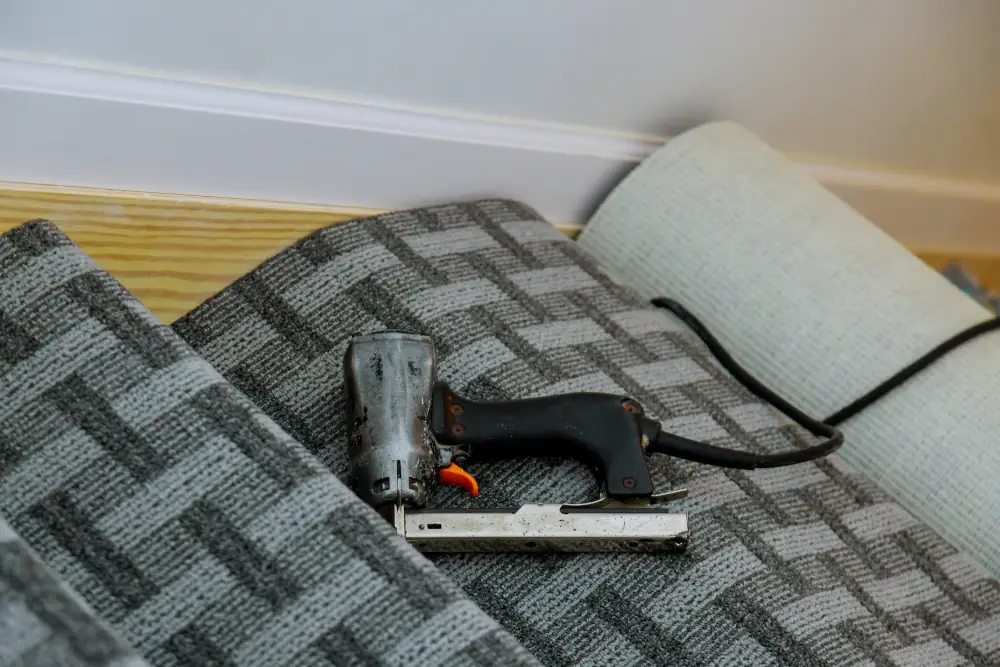
The CRI 105 standard for residential installation spells out the details: a tack strip on every tread, a second strip on each riser for a waterfall install, a nose rounded to about 3/4 to 1 inch so a sharp edge can’t cut the carpet or pad, and the pile running down the stairs, as most manufacturers recommend. Those details are what keep stair carpet tight for years, and they are why stairs are worth leaving to a trained crew. Our installers are in-house professionals, and every installation carries our lifetime labor warranty.
Should You Carpet the Whole Staircase or Add a Runner?
Full stair carpet covers every tread and riser from side to side. It gives the most grip and the quietest steps, and it usually goes in with the same carpet as the hallway and rooms upstairs. A stair runner is a strip of carpet down the middle of wood stairs, with the wood showing on each side. It keeps the look of the wood, adds grip where people walk, and covers the scratches a dog’s nails leave on the treads.
At Carpet Now, a pre-made runner averages $650 to $1,200 and installs in one day once the material is on site. A custom runner, cut from any of our carpets and bound at the edges, averages $1,900 to $2,500 and takes 2 to 4 weeks. Our stair runner guide explains both options.
How Much Does It Cost to Carpet Stairs?
Stairs are priced as their own line on every Carpet Now quote, because each step takes more time to install than a flat room. Our free cost calculator prices a staircase of up to 16 steps as 120 square feet of carpet at the rate of the carpet you pick, plus a $250 stair fee, and both are part of your written quote.
The total depends on the number of steps, whether the staircase turns at a landing or has open sides, and which installation method you choose. A straight run of 13 steps fits the calculator’s single-staircase price, while a staircase with a landing and fanned steps at the turn takes more carpet and more time. Our carpet installation cost guide explains how the rest of the price comes together, and the free cost calculator shows your installed price for the rooms in under a minute. For a price that includes your stairs, schedule a free in-home estimate and we’ll measure them while we’re there.
Ready to Find the Right Carpet for Your Stairs?
We bring samples to your home, so you can see how each one looks on your own steps and in your own light. We serve Austin, Dallas, Fort Worth, Houston and San Antonio. Schedule your free in-home estimate and we’ll measure your stairs, help you pick a carpet that holds up, and give you a complete price on the spot.
Pick your stair carpet on your own stairs.
We bring samples in every fiber and style, measure your stairs while we’re there, and give you a complete price on the spot, with the stairs broken out on their own line.